Improving industrial motor efficiency is crucial for reducing energy costs and environmental impact. According to the International Energy Agency (IEA), industrial motors account for approximately 60% of global electricity consumption in the manufacturing sector. This significant usage underscores the need for better practices.
Experts emphasize actionable strategies in this field. Dr. Emily Watson, a leading authority on energy efficiency, states, "Optimizing motor performance can lead to significant savings and lower carbon footprints." Her insights highlight the importance of understanding how to improve industrial motor efficiency, especially in a rapidly evolving technological landscape.
However, many organizations still overlook basic steps. Simple changes, like routine maintenance and advanced motor controls, are often neglected. This lack of action raises questions about commitment to efficiency. Industries must start prioritizing these improvements to meet both economic and environmental goals. Addressing these gaps can drive substantial progress in motor efficiency worldwide.
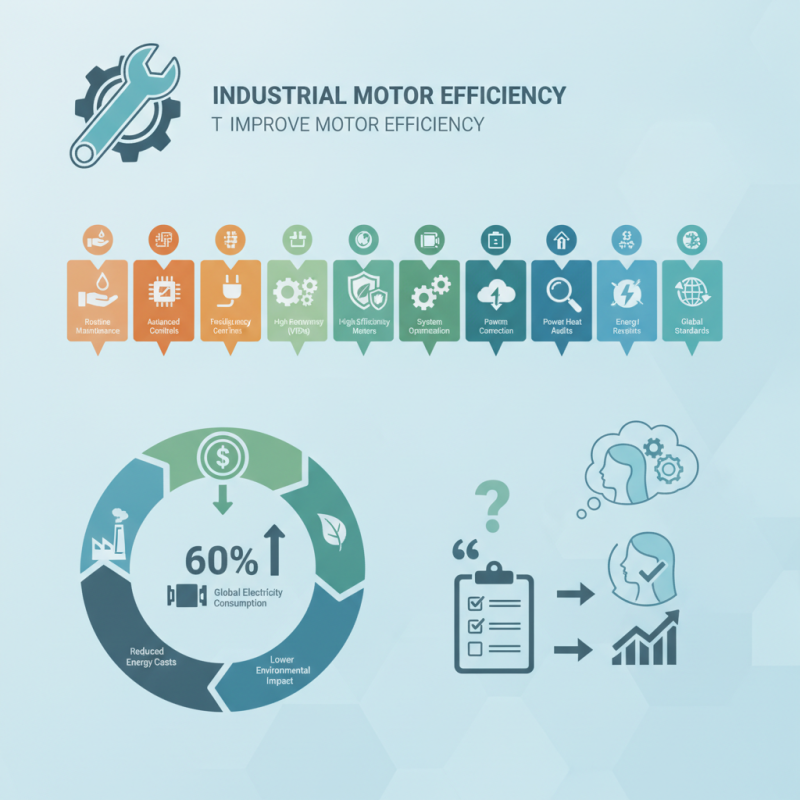
Understanding industrial motor efficiency metrics is crucial for improving performance. Various metrics, such as efficiency percentage and power factor, determine how well a motor converts electrical energy into mechanical energy. The efficiency of an industrial motor can significantly vary based on design and operational conditions. Generally, higher efficiency ratings mean better energy usage and lower operational costs for manufacturers.
Adopting global standards, like the IE efficiency classes, helps compare motor performance. These classes provide a framework to evaluate motors based on energy consumption. However, achieving compliance can be challenging. Many organizations struggle with outdated equipment that fails to meet these standards. Regular maintenance and upgrades can mitigate these issues, but budget constraints often hinder updates.
Incorporating advanced monitoring tools can enhance performance insights. These tools help track irregularities in motor operation, allowing for timely interventions. Surprisingly, many companies overlook these technologies, relying on traditional methods instead. This reluctance can result in inefficiencies that cost time and resources, making it essential to reassess operational strategies consistently.
Variable Frequency Drives (VFDs) play a crucial role in enhancing industrial motor efficiency. They allow precise control over motor speed and torque. According to the U.S. Department of Energy, VFDs can reduce energy consumption by up to 50% in various applications. This optimization leads to significant cost savings and reduced environmental impact.
Implementing VFD technology can be challenging. Some organizations face initial investment hurdles. Concerns about the complexity of installation and maintenance arise. However, the long-term benefits often outweigh these issues. A report from the International Energy Agency indicates that as much as 30% of industrial energy use could be saved with effective VFD deployment.
Moreover, the efficiency gains from VFDs could lead to improved systems reliability. A study from the Electrical Engineering Institute reveals that systems with VFDs experience fewer mechanical failures. This enhances the overall lifespan of motors and components. Nonetheless, industries must continuously assess their setup and embrace modernization for optimal outcomes. Embracing advanced control technologies is a step toward a more energy-efficient future.
Predictive maintenance is transforming how industries manage motor efficiency. By leveraging data analytics, companies can forecast failures before they occur. This proactive approach minimizes unplanned downtime. It also maximizes motor performance, promoting longevity and reducing costs.
Data-driven insights enable technicians to pinpoint issues. For instance, vibration analysis can reveal potential mechanical problems. Thermography detects overheating components. These methods lead to timely repairs, enhancing overall efficiency. However, implementing these systems takes time and investment.
Training staff to interpret data is essential but often overlooked. While predictive maintenance offers many benefits, challenges remain. Many firms struggle with technology adoption. There’s also the risk of relying too heavily on data, potentially missing out on human intuition.
Industries need to find a balance. Regular training will help teams adapt effectively over time. Ultimately, embracing predictive maintenance can significantly improve motor efficiency.
Advanced materials play a crucial role in enhancing motor design and durability. They enable manufacturers to create lighter, stronger components. For instance, high-performance composites and alloys can reduce weight while improving strength. This change directly impacts the efficiency of industrial motors, allowing them to run cooler and last longer.
Incorporating innovative materials often poses challenges. Not all materials exhibit the same performance under varying conditions, which could lead to unexpected failures. It's essential to test these materials rigorously. Engineers must constantly evaluate how different substances behave in real-world applications. This reflection helps in developing more reliable motor designs.
Durability is a key factor in motor efficiency. Using advanced coatings can further protect components from wear and corrosion. Yet, improper application or material choice can lead to reduced performance. The cycle of improvement is ongoing, and every step must be scrutinized carefully. The future of industrial motors heavily depends on these advancements.
Training employees on motor efficiency is crucial for improving industrial performance. These programs should cover the basics of energy consumption, maintenance practices, and optimal operating procedures. Employees need to understand how their actions affect motor efficiency. Awareness leads to mindfulness in daily operations.
Practical, hands-on workshops enhance learning. Simulations can demonstrate the impact of proper alignment and load management. Real-world examples can ground theories in daily reality. Measuring improvements in energy savings after training creates a sense of accomplishment. Employees often need reminders that small changes make big differences.
Evaluating the effectiveness of training programs is essential. Gathering feedback helps identify knowledge gaps. Adjusting curricula based on this feedback can lead to better outcomes. Noticing recurring issues can highlight areas demanding more training focus. Striving for continuous improvement should be the goal. Engaging employees in discussions on efficiency fosters a culture of innovation and accountability.
| Method | Description | Expected Efficiency Gain (%) | Implementation Cost ($) |
|---|---|---|---|
| Regular Maintenance | Conduct regular inspections and servicing of motors to ensure optimal performance. | 5-10% | 500 |
| Training Programs | Educate employees on best practices for operating and maintaining motors. | 3-8% | 1,000 |
| Variable Frequency Drives | Install VFDs to control motor speed and reduce energy consumption. | 20-50% | 2,500 |
| Energy Audits | Perform energy audits to identify inefficiencies and optimize usage. | 5-15% | 1,500 |
| Proper Sizing | Ensure motors are correctly sized for their application to avoid overloading. | 10-20% | 2,000 |
| High-Efficiency Motors | Upgrade to high-efficiency motor models that meet current energy standards. | 10-30% | 5,000 |
| Heat Recovery Systems | Implement systems to capture and reuse waste heat generated by motors. | 15-25% | 3,500 |
| Load Management | Optimize load distribution on motors to prevent cyclical stress and overheating. | 5-12% | 1,200 |
| Power Factor Correction | Adjust power factor using capacitors to improve efficiency and reduce losses. | 10-20% | 2,000 |
| Integrated Control Systems | Use advanced control systems for real-time monitoring and management of motors. | 15-30% | 4,000 |
: They determine how well a motor converts electrical energy into mechanical energy. Higher efficiency means better energy usage.
Standards like IE classes provide a framework for comparing energy consumption. Compliance can be challenging for many organizations.
Many have outdated equipment that fails to meet standards. Budget constraints often hinder maintenance and upgrades.
They track irregularities in operation, enabling timely interventions. Many companies still rely on traditional methods, leading to inefficiencies.
VFDs enable precise control of motor speed and torque. They can reduce energy usage by up to 50% in various applications.
Initial investment costs and complexity of installation can be challenging. However, long-term benefits typically outweigh these concerns.
Systems with VFDs experience fewer mechanical failures, improving motor lifespan. Continuous assessment is necessary for optimal outcomes.
They create lighter and stronger components, impacting efficiency. Testing for performance under varying conditions is essential.
Not all materials perform well in all situations, leading to potential failures. Regular evaluation is crucial for reliability.
Advanced coatings protect components from wear and corrosion. Improper application can harm performance, requiring careful scrutiny.
Improving industrial motor efficiency is crucial for energy savings and operational effectiveness. To achieve this, it is essential to understand the metrics and standards that define motor efficiency, allowing organizations to benchmark their performance accurately. One significant method to improve industrial motor efficiency is by evaluating the impact of Variable Frequency Drives (VFDs), which can optimize energy use and reduce operational costs.
Additionally, implementing predictive maintenance strategies can identify potential issues before they escalate, ensuring motors are always operating at peak performance. Utilizing advanced materials in motor design enhances durability and efficiency, leading to longer lifespans and reduced energy consumption. Finally, conducting training and awareness programs for employees about best practices in motor efficiency can create a culture of continuous improvement and innovation, ensuring that everyone is aligned in the goal of how to improve industrial motor efficiency effectively.

KPR Motor