What Are the Different Types of Industrial Motors?

Time:2026-10-17 Author:Sienna
0%

Choosing the right industrial motor begins with a practical question: what are the different types of industrial motors, and where does each type perform best?

Industrial motors convert electrical energy into controlled mechanical motion. They drive pumps, conveyors, compressors, fans, mixers, cranes, and machine tools. Their differences involve construction, starting behavior, speed control, efficiency, maintenance, and operating environment. A motor beside a dusty cement conveyor faces different demands than one powering a clean-room pump.

Stephen J. Chapman, author of Electric Machinery Fundamentals, states, “The purpose of a motor is to convert electrical energy into mechanical energy.” That simple definition supports a deeper comparison. AC induction motors remain common because they are rugged, affordable, and relatively easy to maintain. Synchronous motors can provide precise speed and power-factor benefits. DC motors offer strong starting torque and straightforward speed control, although brushes may increase maintenance. Brushless DC motors and permanent-magnet motors can deliver high efficiency in compact equipment. Servo motors suit applications requiring accurate position control. Stepper motors move in defined increments, but they may lose synchronism under excessive loads.

This classification is useful, though imperfect. Real installations often combine motor types with variable-frequency drives, sensors, and protection systems. Selection also depends on torque curves, duty cycles, voltage, ambient temperature, and service access. A technically impressive motor can still be the wrong choice.

The sections ahead will compare each motor type, explain its working principles, and connect specifications with real industrial decisions. Performance matters. Reliability matters more when production cannot stop.
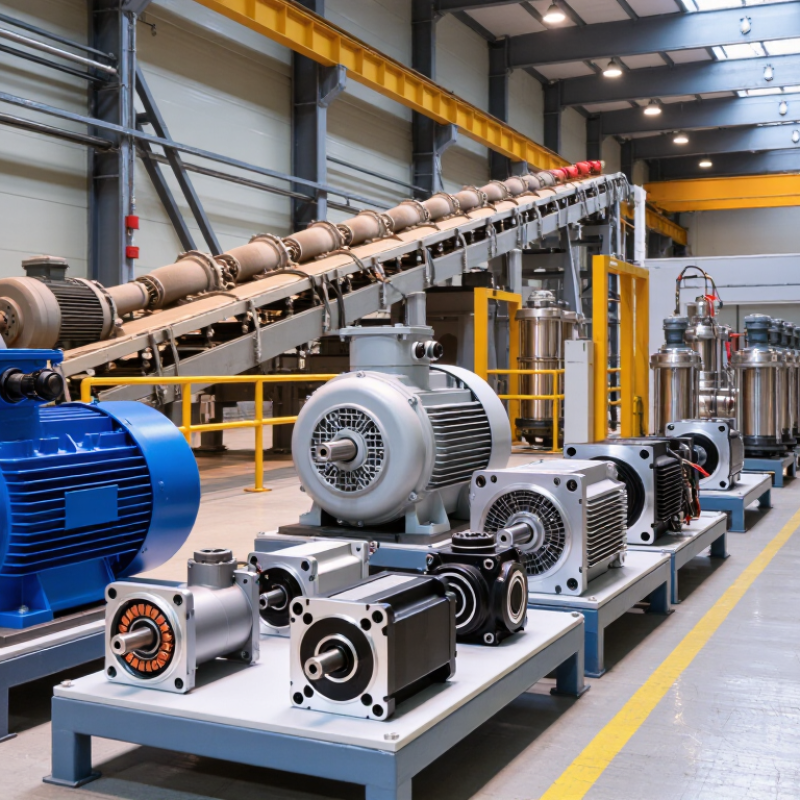
What Are the Different Types of Industrial Motors?

What Industrial Motors Are and How They Work

What Are the Different Types of Industrial Motors?

What Industrial Motors Are and How They Work

Industrial motors convert electrical energy into mechanical motion. They drive pumps, conveyors, compressors, fans, and machine tools. Inside the motor, magnetic fields create force around a rotor. The rotor turns a shaft, which transfers torque to equipment. In alternating-current induction motors, current flows through stationary windings. The rotating magnetic field then induces current in the rotor. This interaction produces continuous rotation. Simple in principle. Demanding in practice.

Different motor types suit different operating conditions. Induction motors are durable and widely used for steady loads. Synchronous motors maintain precise speed under changing demands. Direct-current motors offer strong starting torque, but brushes require maintenance. Brushless motors reduce wear and support accurate control. Servo motors combine feedback with rapid position adjustment. Variable-speed drives can change motor speed and reduce mechanical stress.

Selection should begin with the real load, not a catalog label. Technicians check torque, speed, voltage, duty cycle, enclosure rating, and ambient temperature. A dusty workshop needs better protection than a clean control room. Heat, vibration, and unusual noise often reveal developing faults. Insulation testing and bearing inspections can prevent expensive stoppages. A motor may appear correctly sized and still perform poorly. Poor alignment, frequent starts, or an underestimated load can change everything. That is where careful measurement matters. Practical judgment still has limits.

How Industrial Motors Are Classified by Design and Power

Industrial motors are commonly classified by electrical design, enclosure, phase, and rated power. AC induction motors dominate pumps, fans, conveyors, and compressors because their construction is simple and durable. Synchronous motors maintain nearly constant speed under changing loads. DC motors offer straightforward speed control, while servo motors provide precise movement for robotics and positioning equipment. Reluctance designs can deliver efficient operation, but their control systems require careful matching.

Power classification helps engineers match a motor to the machine and electrical supply. Small motors often serve tools, actuators, and light conveyors. Medium-power motors drive processing lines, pumps, and air-handling systems. Large motors support heavy crushers, mills, and high-capacity compressors. Voltage matters too. Low-voltage units suit many factory machines, while medium-voltage motors reduce current in demanding installations. Rated power alone is not enough. Starting torque, duty cycle, speed, and efficiency can change the correct choice.

Design details reveal how a motor will survive its surroundings. Open frames allow cooling but need clean, dry locations. Totally enclosed housings resist dust and moisture more effectively. In washdown areas, shaft seals and corrosion-resistant finishes deserve close attention. A practical maintenance lesson is simple: heat, vibration, and repeated starts expose weak selections quickly. The frame matters. I would also challenge one common assumption: the largest motor is not always the safest choice. Oversizing can increase purchase cost, idle losses, and control problems. Selection should follow measured load data, service conditions, and verified technical specifications.

AC Motor Types Used in Industrial Applications

What Are the Different Types of Industrial Motors?

AC Motor Types Used in Industrial Applications

Alternating current motors power pumps, fans, compressors, conveyors, and many production machines. Their design affects torque, speed control, efficiency, and maintenance requirements.

The squirrel-cage induction motor remains common because it is rugged, affordable, and simple to maintain. It handles dusty workshops and frequent operating cycles reasonably well. A wound-rotor induction motor provides higher starting torque. It suits heavy conveyors, crushers, and loaded hoists. However, its slip rings require inspection and cleaning. Synchronous motors maintain a nearly constant speed under changing loads. They can also improve power factor in large facilities. Permanent-magnet and synchronous-reluctance motors offer efficient operation, especially with suitable variable-frequency drives.

Selection should begin with the load, not the motor catalogue. Check starting torque, speed range, duty cycle, ambient temperature, enclosure rating, and available voltage. A pump may need smooth speed adjustment, while a conveyor may demand strong starting performance. Three-phase motors generally suit industrial equipment better than single-phase types. Variable-frequency drives can reduce mechanical stress, but incorrect settings may cause overheating or unstable operation. Cable length matters too.

In plant assessments, technicians often find that an oversized motor runs inefficiently at light load. Bigger is not always safer. Maintenance teams should monitor vibration, bearing temperature, insulation condition, and unusual noise. Even a reliable induction motor can fail when ventilation is blocked. Motor choice is sometimes treated as routine, yet the real operating environment deserves closer attention.

What Are the Different Types of Industrial Motors? - AC Motor Types Used in Industrial Applications
Motor Type Electrical Principle Typical Phase and Speed Behavior Main Advantages Limitations Common Industrial Applications Typical Control Method
Three-Phase Squirrel-Cage Induction Motor A rotating magnetic field induces current in a short-circuited rotor cage, producing torque without electrical connections to the rotor. Usually three-phase; rotor speed is slightly below synchronous speed, with slip increasing as load increases. Robust Low maintenance Cost-effective Starting current can be high; speed regulation is limited when operated directly from the supply. Pumps, fans, compressors, conveyors, blowers, machine tools, and general-purpose production equipment. Direct-on-line starter, star-delta starter, soft starter, or variable frequency drive.
Wound-Rotor Induction Motor The rotor contains three-phase windings connected through slip rings, allowing external resistance or control equipment to be added. Three-phase; operates below synchronous speed and can provide controlled high starting torque. High starting torque; reduced starting current; useful for heavy loads with difficult acceleration. More expensive and maintenance-intensive because of slip rings, brushes, and external components. Heavy conveyors, crushers, hoists, elevators, mills, and large machinery requiring controlled acceleration. Rotor-resistance starter, liquid-resistance starter, or variable frequency drive.
Synchronous Motor The rotor magnetic field locks to the rotating stator field, so the rotor runs at synchronous speed under steady-state conditions. Commonly three-phase; speed is determined by supply frequency and pole count and does not vary with load within the pull-out limit. Constant speed; high efficiency at suitable ratings; can correct or improve plant power factor when overexcited. May require a starting system or drive; can lose synchronism under excessive overload. Large compressors, pumps, fans, constant-speed drives, and power-factor correction installations. Damper winding with auxiliary starting, pony motor, or variable frequency drive with synchronization control.
Permanent-Magnet Synchronous Motor Permanent magnets on or inside the rotor create the rotor magnetic field, eliminating rotor excitation losses. Usually three-phase; runs synchronously and commonly operates over a wide speed range with an inverter. High efficiency and power density; excellent dynamic response; no rotor copper losses. Requires an electronic drive in most industrial systems; magnets can be sensitive to excessive temperature or fault conditions. Servo systems, robotics, high-efficiency pumps, compressors, fans, conveyors, and precision production equipment. Variable frequency drive or servo drive with position and current control.
Synchronous Reluctance Motor Torque is produced because the rotor moves toward the position of minimum magnetic reluctance. Typically three-phase; operates synchronously when controlled by an inverter. High efficiency over a broad operating range; rotor has no windings or permanent magnets; good thermal tolerance. Requires a suitable inverter; torque ripple, noise, and power-factor performance depend on motor and control design. Fans, pumps, compressors, conveyors, and variable-speed industrial machinery. Variable frequency drive using rotor-oriented or sensorless control.
Single-Phase Induction Motor A single-phase stator supply creates a pulsating magnetic field; an auxiliary winding or capacitor is used to establish starting torque. Single-phase; operates below synchronous speed and is generally used at smaller power ratings than three-phase motors. Works where three-phase power is unavailable; simple construction and widely available in smaller sizes. Lower starting performance and efficiency than comparable three-phase motors; limited suitability for large industrial loads. Small pumps, fans, blowers, workshop equipment, compressors, and light-duty material-handling systems. Capacitor-start, capacitor-run, shaded-pole, or electronic speed control, depending on the design.
Variable-Frequency Drive Motor System An inverter varies the frequency and voltage supplied to an AC motor to regulate speed, torque, acceleration, and deceleration. Usually paired with three-phase induction, permanent-magnet synchronous, or synchronous-reluctance motors; operating speed is adjustable. Energy savings in variable-torque loads; smooth starting; adjustable speed; process control; reduced mechanical stress. Higher system cost and installation complexity; requires attention to harmonics, electromagnetic compatibility, insulation stress, and cooling. HVAC systems, water treatment, conveyors, mixers, extruders, machine tools, pumps, and compressors. Scalar volts-per-hertz control, sensorless vector control, or closed-loop vector control.
Servo AC Motor A high-response AC motor works with feedback and a digital drive to control position, speed, and torque precisely. Usually permanent-magnet synchronous; speed and position are controlled across a wide range. Very high positioning accuracy; rapid acceleration and deceleration; strong low-speed torque and dynamic response. Higher cost; requires a compatible servo drive, feedback device, tuning, and appropriate mechanical design. Robotic arms, CNC machines, packaging equipment, printing machinery, automated assembly, and precision motion systems. Closed-loop servo drive using an encoder, resolver, or other position-feedback device.

DC and Specialized Industrial Motor Types

What Are the Different Types of Industrial Motors?

DC and Specialized Industrial Motor Types

DC motors remain useful where adjustable speed and strong starting torque matter. Brushed DC motors use mechanical brushes and a commutator. They are simple, responsive, and easy to control. However, brushes wear down and may create maintenance problems in dusty production areas. Brushless DC motors remove this contact point. They offer longer service life, quieter operation, and better efficiency, but their electronic controllers require careful setup.

Specialized industrial motors solve narrower application problems. Servo motors deliver precise position, speed, and torque control. They suit robotic joints, packaging equipment, and automated cutting systems. Stepper motors move in controlled increments. They work well at moderate speeds, although they can lose position under excessive loads. Geared motors increase output torque while reducing speed. Linear motors create direct motion without a rotating shaft. Each design has trade-offs.

Tips: Check the load profile before choosing a motor. Measure starting torque, running speed, duty cycle, and ambient temperature. A motor that works on a test bench may overheat during continuous production. Also inspect vibration, cable routing, and controller compatibility. Engineers sometimes focus too heavily on rated power. That can be a mistake. Real operating conditions matter more than a single label. Allow practical service access, especially around brushed motors and cooling openings.

How to Match Motor Types to Industrial Requirements

Industrial motors differ in how they deliver torque, speed, and control. The common choices include induction, synchronous, DC, servo, and stepper motors. Matching the motor to the duty matters more than choosing the most advanced design. Start with the load. A conveyor needs steady torque, while a robotic joint needs precise positioning. A pump may value smooth speed control and reliable operation near a fixed point.

For harsh, continuous-duty work, an induction motor is often a practical option. It tolerates demanding schedules and usually needs limited maintenance. A synchronous motor suits applications requiring stable speed or improved power factor. Servo motors fit rapid acceleration, feedback, and accurate movement. Stepper motors can control smaller indexed movements, but they may lose position under excessive load. DC motors provide useful speed control, although brush wear can increase service needs. That trade-off is easy to overlook.

Check starting torque, rated load, duty cycle, ambient temperature, enclosure, and available power.
Dust, washdown water, heat, and vibration can change the correct enclosure and cooling method. Measure the real operating cycle rather than relying on a nameplate value alone. Oversizing seems safe, but it can raise purchase and energy costs. Undersizing is worse. It may overheat during repeated starts. A careful selection also considers service access, control hardware, and future production changes. The best match is rarely perfect on paper; field conditions deserve a second review.

FAQS

What is the most common industrial motor type?

AC induction motors are widely used for pumps, fans, conveyors, and compressors. They are rugged and simple to maintain.

When is a synchronous motor a suitable choice?

Choose one when nearly constant speed matters under changing loads. It can also support power factor improvement in larger facilities.

Which motor suits precise positioning equipment?

Servo motors suit robotics and positioning systems requiring feedback, rapid acceleration, and accurate movement. Stepper motors suit smaller indexed movements.

How should motor power be matched to a machine?

Match rated power with actual load, starting torque, speed, duty cycle, and available voltage. Rated power alone is insufficient.

Is a larger motor always safer?

No. An oversized motor may increase purchase costs, idle losses, and control problems. Bigger is not always safer.

What enclosure is suitable for dusty or wet areas?

Enclosed housings resist dust and moisture better than open frames. Washdown areas also need shaft seals and corrosion-resistant finishes.

What should technicians inspect during motor maintenance?

Monitor vibration, bearing temperature, insulation condition, ventilation, and unusual noise. Blocked cooling can damage even reliable motors.

How do variable-frequency drives affect motor operation?

They can reduce mechanical stress and adjust speed smoothly. Incorrect settings may cause overheating or unstable operation.

Should engineers rely only on the motor nameplate?

No. Measure the real operating cycle, environmental conditions, and starting demands. Keep checking; field conditions may challenge the original choice.

Conclusion

Industrial motors convert electrical energy into mechanical motion, powering equipment such as pumps, conveyors, compressors, fans, and production machinery. This overview explains what are the different types of industrial motors and how they operate, from generating rotational force to controlling speed, torque, and direction. It also introduces how motors are classified according to their design, power source, construction, and operating characteristics.

The article reviews common AC motor types, including induction and synchronous designs, as well as DC motors and specialized options for applications requiring precise control, high starting torque, or variable speed. It also highlights the practical differences between motor technologies and explains how to select the right type by evaluating load demands, efficiency, operating environment, maintenance needs, control systems, and available power. Matching these factors correctly can improve reliability, energy performance, and overall production efficiency.

Sienna

Sienna

Sienna is a skilled marketing professional with a deep expertise in our company’s core products and services. With a passion for innovation and detail, she plays a pivotal role in crafting insightful blog posts that not only highlight the unique features of our offerings but also provide valuable......