2026 Best Industrial Motors How to Choose the Right One?

Time:2026-10-12 Author:Isabella
0%

Selecting an industrial motor in 2026 is rarely a simple catalogue decision. Plant conditions, load behavior, operating hours, and maintenance access all affect the final choice. A motor that performs well in a clean workshop may struggle beside dust, heat, moisture, or corrosive chemicals. The right specification must fit the machine and its working environment.

This guide explains how to choose the right industrial motor with practical engineering criteria. It compares induction, synchronous, servo, and high-efficiency motor options. It also considers torque, speed control, duty cycles, enclosure ratings, insulation, and energy consumption. Check IEC or NEMA requirements. Confirm every value against the manufacturer’s datasheet and site conditions.

Numbers can mislead. A high-efficiency rating does not guarantee low operating costs when the motor is oversized. A powerful motor may also create poor control, unnecessary starting stress, and higher purchase costs. Real maintenance records often reveal issues that brochures overlook, including bearing failures, vibration, heat buildup, and difficult access. Measure the actual load when possible. Do not rely only on assumptions from an old motor.

Small details matter. Cable length can influence drive performance. Ambient temperature can reduce usable output. Frequent starts can change the required duty rating. This overview offers a reliable starting point, not a substitute for a qualified assessment. Some applications remain difficult to judge remotely. Careful verification protects equipment, production schedules, and long-term operating budgets.
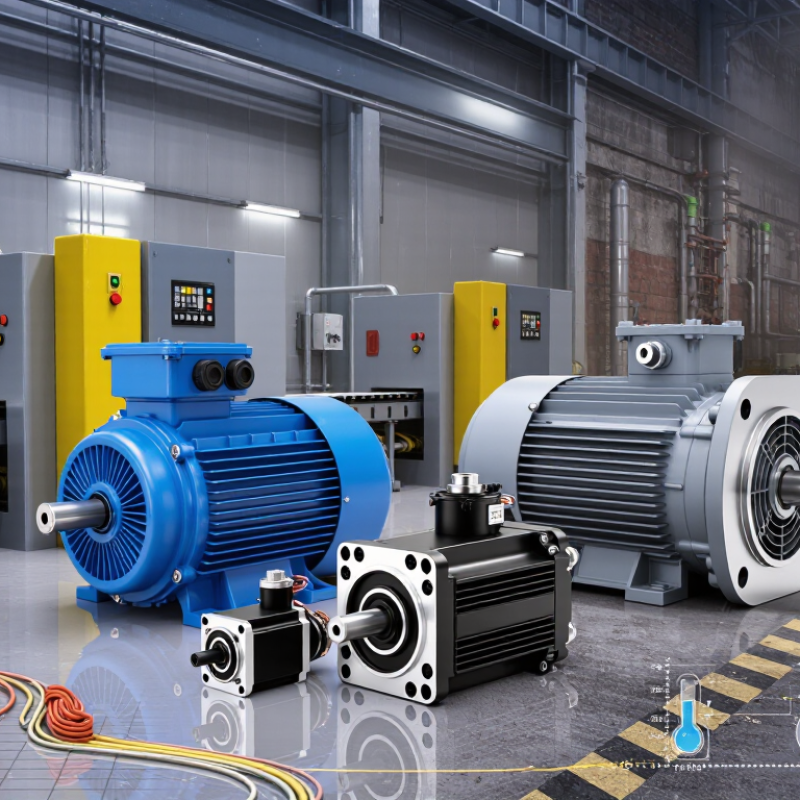
2026 Best Industrial Motors How to Choose the Right One?

Motor Basics: Match IEC 60034-30-1 Classes IE1–IE5 to Efficiency Needs

2026 Best Industrial Motors: How to Choose the Right One?

Motor selection starts with the IEC 60034-30-1 efficiency classes, from IE1 to IE5. IE1 offers basic efficiency, while IE3 and IE4 reduce losses more effectively. IE5 targets the highest efficiency tier under the applicable test method. The IEA reports that electric motor systems consume more than half of global electricity. Small efficiency gains can therefore produce large savings across factories. But an efficiency label is not a guarantee.

Check the motor at its real operating point. A 75 kW motor running at 35% load may waste the benefit of a high IE class. Record shaft load, operating hours, starts per hour, ambient temperature, and supply conditions. Frequency converters also matter. Their switching losses, cable length, and harmonic effects can change total system efficiency. A 2024 analysis from the European Commission emphasizes life-cycle energy performance when assessing industrial equipment, not purchase price alone.

Choose IE3 for many standard-duty installations, then compare IE4 or IE5 when annual running hours are high. Pump, fan, and compressor applications often reward careful speed control. Verify test certificates, rated-load efficiency, temperature rise, enclosure protection, and service history. The IEC method improves comparability, yet field conditions remain imperfect. Real measurements may disagree. That is where engineers should review assumptions, rather than trust the nameplate blindly.

Define Load, Speed, Torque, and Duty Cycle Before Selecting a Motor

Choosing an industrial motor in 2026 starts with the load, not the catalog. A powerful-looking motor may still overheat or stall. Record the starting load, running load, and worst-case resistance. Conveyors, pumps, fans, and crushers behave differently. Measure twice. During plant assessments, I check current draw during startup and steady operation. Nameplate power alone is not enough. Ambient temperature, altitude, dust, and ventilation can change the real requirement.

Speed must match the process, whether fixed or variable. Calculate torque from power and rotational speed, then verify peak torque during acceleration. A gearbox may reduce speed, but it cannot erase shock loads. Define the duty cycle clearly: continuous, intermittent, frequent starts, reversing, or short bursts. A motor rated for continuous duty may fail when a machine starts every few minutes. That mistake is common.

Use service factors carefully, not as a substitute for calculations. Compare efficiency, enclosure protection, insulation class, braking needs, and control method. Request test data and documented ratings from qualified suppliers. Leave a practical margin, but avoid excessive oversizing. An oversized motor can run inefficiently at light load. My earlier selections sometimes favored extra capacity, increasing cost without improving reliability. Recheck assumptions with maintenance staff. They know the vibration, jams, and seasonal changes that a specification sheet can miss.

2026 Best Industrial Motors: How to Choose the Right One? — Define Load, Speed, Torque, and Duty Cycle Before Selecting a Motor

Industrial Motor Selection Guide by Application Requirements
Application / Load Profile Typical Motor Type Continuous Load Range Required Speed Typical Torque Requirement Recommended Duty Cycle Key Selection Considerations Suitable Motor Class
Conveyor with steady material flow Three-phase induction motor 2.2–30 kW 750–1,500 rpm at motor shaft 14–190 N·m at 1,500 rpm S1, continuous operation Allow for starting friction, belt tension, incline angle, and a service margin of approximately 10–20%. Premium-efficiency motor with variable-frequency drive
High-inertia fan or centrifugal pump Three-phase induction motor 5.5–75 kW 1,000–3,000 rpm 18–710 N·m, depending on speed S1, continuous operation Fan and pump torque generally rises with the square of speed; use speed control to reduce energy consumption. High-efficiency motor with inverter-duty insulation
Positive-displacement pump or extruder Induction motor or permanent-magnet motor 7.5–160 kW 300–1,500 rpm 48–5,100 N·m S1 or S6, according to process demand Check constant-torque capability, low-speed cooling, pressure fluctuations, and overload duration. Constant-torque inverter-duty motor
Hoist, crane, or vertical lifting system Brake motor or wound-rotor motor 5.5–90 kW 300–1,500 rpm 35–2,860 N·m S3–S5, intermittent or frequent starts Specify holding brake torque, acceleration time, starts per hour, shock loading, and required fail-safe stopping. Brake-equipped motor with variable-frequency drive
Machine tool spindle Permanent-magnet synchronous motor or spindle motor 3–45 kW 3,000–24,000 rpm 1.2–143 N·m S1 with short S6 overload periods Prioritize speed accuracy, bearing limits, balancing, acceleration time, encoder feedback, and thermal performance. High-speed servo or spindle motor
Robotic axis or precision positioning AC servo motor 0.4–15 kW 1,500–6,000 rpm 0.6–95 N·m S3–S8, repeated acceleration and deceleration Calculate RMS torque, peak torque, reflected inertia, stopping energy, encoder resolution, and thermal regeneration. Servo motor with matched digital drive
Mixer, crusher, or reciprocating compressor Heavy-duty induction motor 15–250 kW 500–1,500 rpm 95–4,775 N·m S1 or S4, with high starting demand Verify locked-rotor torque, acceleration capability, torsional vibration, shock loads, and mechanical coupling strength. High-starting-torque motor with controlled starting
Small actuator, valve, or indexing mechanism Brushless DC motor or small servo motor 50 W–2.2 kW 500–4,000 rpm 0.12–42 N·m S3–S8, intermittent or cyclic operation Confirm holding torque, positioning accuracy, gearbox ratio, backlash, allowable temperature rise, and duty-cycle timing. Integrated brushless or servo actuator
Core sizing formulas: Mechanical power (kW) = Torque (N·m) × Speed (rpm) ÷ 9,550. For variable-load applications, size the motor using RMS torque and peak torque rather than continuous torque alone. Select a motor duty rating that matches the actual operating cycle, including starts, stops, acceleration, idle time, and overload duration.

Compare Induction, Synchronous, Servo, and BLDC Motors by Application

2026 Best Industrial Motors: How to Choose the Right One?

Compare Induction, Synchronous, Servo, and BLDC Motors by Application

Choosing an industrial motor starts with the machine’s behavior, not its nameplate alone. Induction motors suit pumps, fans, compressors, and conveyors with steady loads. They tolerate dust, heat, and occasional overloads well. Their starting current can be high, so the drive and power system need careful sizing.

Synchronous motors maintain accurate speed under changing loads. They work well in compressors, mixers, and high-efficiency production lines. Servo motors fit applications requiring precise position, rapid acceleration, and repeated stops. Packaging axes and robotic joints often need this control. BLDC motors offer compact size, fast response, and efficient operation. They are practical for small conveyors, cooling equipment, and battery-powered machinery.

Measure the real load.

Check torque at startup, running speed, duty cycle, ambient temperature, and available voltage. A motor that looks efficient in a catalog may perform poorly when oversized or poorly cooled. In one factory assessment, a lightly loaded motor ran continuously and wasted energy through unnecessary capacity. The replacement was smaller, but the selection process was not perfect; airflow changes later affected its temperature.

Servo systems also require feedback devices, tuned controls, and clean installation. Induction motors may need less maintenance, but bearings and insulation still deserve regular inspection. BLDC motors can be efficient, yet their electronic controllers add another failure point. Compare total operating cost, service skill, noise, and repair access before approving the final design.

Calculate Lifecycle Cost Using Efficiency, Runtime, and Energy-Price Data

Choosing an industrial motor by purchase price can hide its largest expense: electricity. The U.S. Department of Energy estimates that motor-driven systems consume about 69% of industrial electricity in the United States. Therefore, lifecycle cost should begin with operating data, not the catalog price.

Use this formula: lifecycle cost equals purchase, installation, maintenance, and energy costs. Energy cost equals input kilowatts multiplied by annual runtime and electricity price. For example, a 75 kW motor running 6,000 hours yearly at $0.12 per kWh costs about $54,000 in electricity each year. A 3% efficiency improvement saves roughly $1,620 annually, before considering load variation. The International Energy Agency also identifies motor systems as a major global efficiency opportunity, supporting closer attention to system-level losses.

Measure the real load.

Do not assume full-load operation. Record operating hours, start-stop cycles, power factor, and tariff periods for several weeks. A motor running 3,000 hours may outperform a larger unit running inefficiently at light load. Maintenance reports matter too, because poor alignment, blocked cooling paths, and worn bearings can raise energy use. IEC efficiency classes help comparison, but they do not replace field measurements. My calculation may still be imperfect when production demand changes. That uncertainty should be tested with low, normal, and high energy-price scenarios before approval.

Verify 0.12–1,000 kW Ratings, 2–8 Poles, IP Codes, and IEC Compliance

Choosing an industrial motor starts with verified data, not a catalog headline. Confirm the required rating from 0.12 to 1,000 kW, then match it to the load profile. Continuous loads, frequent starts, and variable torque can demand different motor designs. A motor’s rated power alone is not enough.

Check the pole count carefully. Two poles provide higher speed, while four, six, or eight poles deliver lower speed and stronger torque. Confirm voltage, frequency, duty cycle, starting current, and efficiency records. IP codes also matter. For example, IP55 offers protection against dust and water jets, but it may not suit washdown or corrosive areas. IEC compliance should be supported by clear technical documents, test reports, and declared operating limits. A spreadsheet may look complete while missing one important detail.

Tips: Ask for the nameplate, dimensional drawing, efficiency data, and compliance declaration. Compare the motor’s actual duty with site conditions, including heat, dust, humidity, and altitude. Leave practical service access around the motor. I have seen selections fail because maintenance space was ignored. Recheck assumptions with a qualified engineer, especially near the smallest 0.12 kW ratings or the largest 1,000 kW systems.บาคาร่า

FAQS

What do IE1 to IE5 efficiency classes mean?

IE1 provides basic efficiency. IE3 and IE4 reduce losses more effectively. IE5 targets the highest applicable efficiency tier. Higher is not always better.

When should an industrial motor use IE4 or IE5?

Compare IE4 or IE5 when annual operating hours are high. Heavy-duty pumps, fans, and compressors may justify the extra cost. Check real savings.

Why can a highly efficient motor still waste energy?

Operating conditions matter. A 75 kW motor running at 35% load may lose its expected advantage. Measure shaft load and input power.

How is motor lifecycle cost calculated?

Add purchase, installation, maintenance, and energy costs. Energy cost equals input kilowatts multiplied by annual hours and electricity price.

What could a 75 kW motor cost to operate yearly?

At 6,000 hours and $0.12 per kilowatt-hour, electricity costs about $54,000 yearly. A 3% efficiency gain may save around $1,620. Actual savings vary.

What operating information should engineers record?

Record load, runtime, start-stop cycles, power factor, tariffs, temperature, and supply conditions. Measure for several weeks. Assumptions can be wrong.

How do ratings, poles, and IP codes affect motor selection?

Confirm ratings from 0.12 to 1,000 kW. Two poles provide higher speed. Four to eight poles provide lower speed and stronger torque.

What documents should be checked before approving a motor?

Request the nameplate, dimensional drawing, efficiency records, test reports, and compliance declaration. Verify voltage, frequency, duty cycle, and starting current.

How can a frequency converter change total efficiency?

Switching losses, long cables, and harmonics can reduce system efficiency. Review the complete motor and converter system, not the motor alone.

What maintenance issues can increase motor energy use?

Poor alignment, blocked cooling paths, and worn bearings may raise energy consumption. Leave clear service access around the motor. Small details matter.

Why should energy savings be tested under different scenarios?

Production demand and electricity prices change. Compare low, normal, and high-use cases before approval. My calculation may still be imperfect.

Conclusion

Selecting the right industrial motor begins with understanding the application rather than choosing by price alone. First, define the required load, operating speed, torque, starting conditions, and duty cycle. Then compare induction, synchronous, servo, and BLDC motors according to the machine’s need for constant speed, precise positioning, rapid response, or energy efficiency. IEC 60034-30-1 efficiency classes from IE1 to IE5 can help match motor performance with operational and sustainability goals.

A complete evaluation should also include lifecycle cost, calculated from motor efficiency, annual runtime, load profile, maintenance needs, and local energy prices. Before purchase, confirm that the available rating, from approximately 0.12 to 1,000 kW, suits the equipment, and check the number of poles, enclosure IP code, installation conditions, and applicable IEC requirements. By combining technical specifications with long-term operating costs, users can make a practical decision about how to choose the right industrial motor for reliable, efficient, and safe performance.

Isabella

Isabella

Isabella is a dedicated marketing professional with a sharp focus on driving brand growth and engagement through strategic content creation. With an extensive background in digital marketing, she combines her passion for storytelling with her keen understanding of industry trends to deliver......