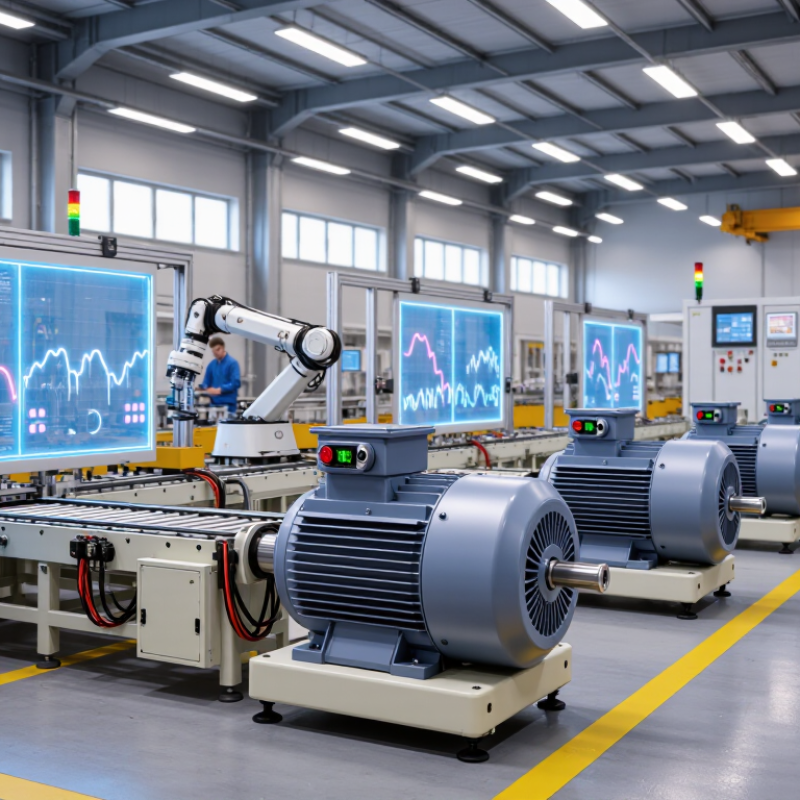
The question “how do industrial motors support smart factories” is central to selecting the best industrial motors for 2026. Motors convert digital instructions into physical movement. They drive conveyors, pumps, robotic arms, compressors, and precision tools across modern production lines.
Smart factories need more than raw horsepower. They need motors that communicate operating data, respond quickly, and use energy efficiently. Integrated sensors can track vibration, temperature, current, and bearing condition. A rising vibration level may reveal misalignment before a conveyor stops beside a busy assembly cell. Variable frequency drives can adjust speed according to real production demand. This reduces energy waste and limits mechanical stress.
Peter Herweck, an industrial automation leader and former Siemens CEO, stated, “The industrial metaverse will revolutionize the way we design, manufacture, and operate.” His observation supports a wider point: connected equipment must work as part of a complete digital system, not as isolated machinery.
Reliability matters most.
The strongest 2026 motor may combine high efficiency, predictive-maintenance data, flexible connectivity, and simple service access. However, specifications alone do not guarantee factory performance. A technically advanced motor can underperform when sensors are poorly calibrated, networks are unstable, or technicians lack training. That weakness deserves attention.
This guide compares motor technologies, control methods, efficiency classes, and monitoring features for smart manufacturing. It also considers installation conditions, maintenance experience, and total ownership cost. Some recommendations may change after real plant testing. That is acceptable. Practical evidence should challenge attractive claims before a factory commits its budget.
What Makes an Industrial Motor Suitable for Smart Factories in 2026?
A suitable industrial motor must do more than produce reliable torque. It should communicate operating data clearly and continuously. Built-in sensors can track temperature, vibration, speed, load, and energy consumption. This information helps maintenance teams detect bearing wear before a production stoppage occurs. In factory assessments, simple data often proves more useful than complicated dashboards. Motors should also support variable-speed control, accurate positioning, and smooth starts. These features reduce mechanical stress and improve process consistency. High efficiency matters, especially where motors run for many hours daily. However, efficiency claims need testing under real loads, not only laboratory conditions.
Tips: Check the motor’s communication options, sensor accuracy, service access, and compatibility with existing control systems. Ask for test results at different loads. Small details matter.
Smart-factory motors also need strong thermal performance and practical cybersecurity controls. Secure data transmission, controlled access, and regular firmware updates protect connected equipment. Maintenance software should provide understandable alerts, not endless warnings. A technician standing beside a noisy conveyor needs clear guidance quickly. Remote monitoring is valuable, but it cannot replace physical inspection. Dust, heat, misalignment, and poor lubrication still cause failures. No motor is perfectly smart. A promising model may perform poorly if installation quality is overlooked. Selection should therefore consider duty cycle, enclosure protection, ambient conditions, repair support, and spare-part availability. Teams should record actual energy use after installation and compare it with expected performance. That comparison may reveal uncomfortable gaps, but it supports better decisions.
A practical, brand-neutral comparison of motor technologies and selection criteria for connected industrial automation
| Motor Technology | Typical Power Range | Typical Efficiency Position | Best Smart-Factory Applications | Feedback and Sensor Capability | Variable-Speed Suitability | Predictive-Maintenance Potential | Key Selection Consideration |
|---|---|---|---|---|---|---|---|
| Premium-efficiency induction motor | 0.12–1,000 kW and above | IE3 or IE4 depending on rating, design, and applicable regional requirements | Pumps, fans, compressors, conveyors, machine tools, and general-purpose production equipment | Works well with external temperature, vibration, current, speed, and load sensors | Best when paired with a properly sized variable-frequency drive |
Large installed base and widely understood condition indicators |
Check inverter-duty insulation, bearing-current protection, cooling performance, and low-speed torque |
| Permanent-magnet synchronous motor | Approximately 0.1–500 kW | Often capable of IE4 or IE5 performance, subject to the complete motor-drive system | High-duty conveyors, compressors, robotics auxiliaries, pumps, fans, and energy-sensitive machinery | Usually integrated with encoder or resolver feedback; supports temperature and rotor-position monitoring | Excellent torque density and efficient operation across variable loads |
Electrical signature, temperature, vibration, and demagnetization-related diagnostics can be monitored |
Requires compatible control electronics and careful thermal management; magnets may increase lifecycle cost |
| Synchronous reluctance motor | Approximately 0.75–500 kW | Commonly designed for IE4 performance; system efficiency depends strongly on the drive | Continuous-process lines, pumps, fans, compressors, and applications requiring efficient variable-speed operation | Supports drive-based monitoring plus external vibration, temperature, current, and load sensors | Strong option for efficient speed control over a broad operating range |
Drive data and mechanical-condition sensors provide useful operating trends |
Motor and drive should be selected as a matched system; verify starting behavior and minimum-speed capability |
| Servo motor | Approximately 0.05–100 kW | Efficiency varies by design, operating point, feedback device, and drive configuration | Robotic axes, packaging, assembly, indexing, electronic production, and precision motion control | High-resolution encoder or resolver feedback; drive can provide position, speed, torque, and fault data | Designed for rapid acceleration, deceleration, positioning, and torque control |
Motion profiles, following error, torque, temperature, and vibration trends are available |
Specify continuous and peak torque, duty cycle, inertia matching, braking, backlash, and communication interface |
| Brushless DC motor | Approximately 0.01–30 kW | Typically efficient at small and medium power ratings; exact performance depends on speed and load | Compact automation modules, material handling, cooling systems, pumps, and light-duty production equipment | Hall sensors, encoders, current sensing, temperature sensing, and drive diagnostics are commonly available | Suitable for frequent speed changes and compact variable-speed systems |
Useful electronic and thermal data, although industrial sensor ecosystems vary |
Confirm continuous torque, overload capability, cooling method, controller compatibility, and expected service life |
| Geared motor | Approximately 0.05–200 kW | Combined efficiency depends on motor class, gear ratio, gearbox design, lubrication, and load | Conveyors, palletizers, automated storage systems, mixers, and low-speed high-torque machinery | Motor temperature and current can be monitored; gearbox vibration, oil temperature, and speed sensors add value | Provides controlled low-speed output and high starting torque |
Gearbox vibration, oil condition, temperature, and torque are valuable diagnostic indicators |
Evaluate gearbox service factor, backlash, lubrication method, output bearing loads, sealing, and mounting orientation |
| Explosion-protected industrial motor | Approximately 0.12–500 kW | IE3 or IE4 options may be available, subject to certification, enclosure design, and operating conditions | Chemical processing, fuel handling, dust-risk areas, paint systems, and other classified hazardous locations | External or certified sensors may be used; monitoring hardware must comply with the area classification | Variable-speed operation requires certified motor-drive combinations |
Condition monitoring is valuable when sensors and installation methods meet hazardous-area rules |
Verify gas or dust group, temperature class, protection method, zone or division, certification, and cable installation requirements |
| Integrated smart motor system | Approximately 0.1–150 kW | Efficiency depends on the motor, integrated electronics, duty point, and control strategy | Distributed conveyors, modular machines, compact production cells, and decentralized automation architectures | May include built-in current, temperature, speed, torque, vibration, and operating-hour data | Designed for networked speed and torque control with reduced cabinet wiring |
Embedded diagnostics can provide standardized operating and fault information |
Assess thermal limits, network redundancy, cybersecurity, firmware support, interoperability, and serviceability |
Reference note: Power ranges and efficiency positions are typical engineering selection ranges rather than guaranteed product specifications. Final motor selection should consider IEC 60034 requirements, applicable efficiency regulations, duty cycle, load profile, ambient conditions, enclosure rating, braking, control method, hazardous-area classification, and the complete motor-drive system.
It should deliver reliable torque and communicate operating data continuously. Built-in sensors can track temperature, vibration, speed, load, and energy use. Clear data matters more than impressive dashboards. No motor is perfectly smart.
Bearing temperature, vibration, winding temperature, and insulation condition provide useful warning signs. Rising vibration may indicate misalignment or bearing wear. Maintenance teams can respond before a conveyor stops. Still, sensor placement can create false confidence.
Measure efficiency across the actual duty cycle, not only at rated load. Record energy use every fifteen minutes during a full production week. Compare real results with expected performance. Paper ratings can disappoint.
Induction motors often suit pumps, conveyors, and steady-speed loads. Permanent-magnet motors can provide high efficiency and strong torque in compact spaces. Servo motors support precise robotic positioning. Synchronous-reluctance motors may reduce rotor losses, but their controls need careful validation.
Check communication options, encoder resolution, overload capacity, braking needs, and network compatibility. Confirm that the motor works with existing drives and control systems. Test speed, torque, and temperature before final approval. Compatibility problems are expensive.
No. Technicians should still inspect dust, heat, alignment, lubrication, cables, and washdown exposure. A noisy conveyor may reveal problems that software misses. Remote data helps, but it is not a complete inspection.
Use secure data transmission and controlled user access. Apply firmware updates through a managed process. Separate monitoring permissions from maintenance permissions when practical. Security plans should be simple enough for technicians to follow.
Consider duty cycle, enclosure protection, ambient heat, dust, moisture, frequent starts, and service access. A motor may perform well on a test bench but struggle beside a hot conveyor. Spare-part availability and repair support also matter. Installation quality is sometimes underestimated.
Compare purchase price, energy use, maintenance hours, downtime risk, commissioning labor, and cable replacement. Review payback calculations carefully. They may ignore uncomfortable costs. The cheapest motor is not always the least expensive choice.
In 2026, the best industrial motors for smart factories will combine dependable mechanical performance with digital intelligence. Suitable motors should support automated manufacturing through accurate speed control, high torque efficiency, low vibration, and reliable operation under demanding workloads. Comparing motor types requires attention to application needs, including variable-speed processes, frequent starts and stops, load patterns, environmental conditions, and compatibility with modern drive systems. Key selection metrics include energy efficiency, power density, thermal stability, service life, noise levels, maintenance requirements, and total operating cost.
How do industrial motors support smart factories? By integrating sensors and connectivity, they can provide real-time data on temperature, vibration, current, speed, and operating conditions. This information enables condition monitoring and predictive maintenance, helping identify wear before it causes unplanned downtime. A complete evaluation should also consider installation requirements, safety protections, system integration, energy consumption, and long-term replacement costs. The ideal motor is not simply the most powerful option, but the one that delivers efficient, safe, measurable, and adaptable performance throughout the factory’s operational lifecycle.

 KPR Motor